
About Merven
We started Merven because we'd lived through the rewrite.
Every software company eventually faces the same decision: rebuild on a modern stack, or watch the old one slowly bleed velocity, hiring, and customers. We spent years on the wrong side of that decision. Then AI made the right side possible. Merven is what we wish had existed.
Why we exist
The rewrite that almost broke us.
Ranjeet Rustogi had been CTO at Suke TV Network for 3 years when the rewrite question landed. The product was 10 years old, built on PHP, and slowing down. Every senior engineer interview ended the same way: a polite no after seeing the codebase. Every roadmap review ended the same way: half the features cut. Every board meeting ended the same way: "When will velocity recover?"
The plan was 9–12 months. It took 24. By the time it shipped, two senior engineers had left, a competitor had passed us on the features we'd promised, and the board had quietly written down the year. The rewrite worked, technically. But the cost of getting there was the kind of thing you only fully understand after you've paid it.
That experience, and a half-dozen versions of it told to us by other engineering leaders, is the reason Merven exists.
We started Merven in 2025 when it became obvious that agentic AI could finally take on the work that made rewrites brutal: the parallel rebuild, the test backfill, the schema migration, the long tail of feature-by-feature porting. Not by replacing engineers, but by absorbing the work that should never have required them in the first place.
The rebuild is no longer a multi-year project. It can be a quarter. That changes everything about how software companies grow.
Who we are
The team.
Merven is built by engineers who've shipped real products at real scale, and who've felt firsthand what it costs when the foundation underneath them stops keeping up.

Ranjeet Rustogi
Co-founder & CTO
A prolific tech inventor, architect, and visionary. Conceived, designed, and built a wide range of breakthrough, large-scale high-performance disruptive solutions on bleeding-edge technologies across 10+ verticals.
Where I've shipped:




Advisors

Omar Nawaz
He has led modernization efforts as a CEO and CPTO at various enterprise and growth-stage VC startups. Omar has seen firsthand how legacy systems slow enterprise velocity and what it takes to unlock value creation.


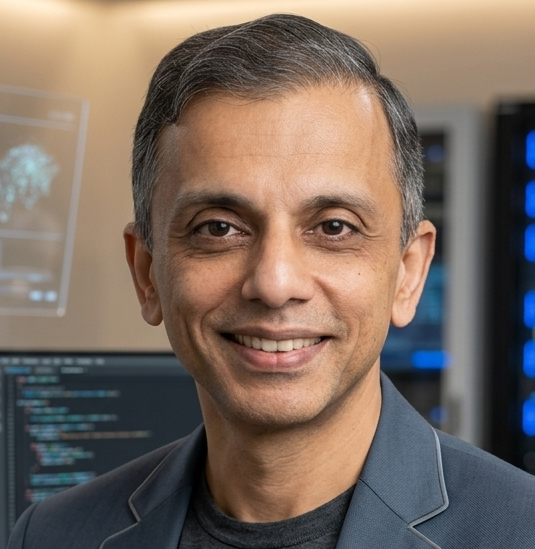
Nilendu Misra
He has led multiple pre-IPO and PE-owned shops in CPTO and VP of Eng roles. Nilendu has solved some of the thorniest technical challenges in Payments, Mobility, and Infra.






Mitch Halligan
He has spent three decades leading engineering teams tackling large scale modernization and 3rd party replacements. Mitch has a deep understanding of SaaS scalability, flexibility, and performance.


What we believe
Five things we believe about software, and won't compromise on.
The rewrite is a product problem, not a tooling problem.
Most attempts to make rewrites easier are tools sold to engineers. The actual blocker is organizational: the team can't stop shipping. So we built a company that does the rebuild for you, not a tool that helps you rebuild yourself.
Most features in a mature codebase aren't worth carrying forward.
Every product has a long tail of features that exist because someone asked for them in 2017. Rebuilding everything is the lazy path. We rebuild what earns its place.
Your engineers are not the problem.
They're the reason your product still exists. The point of agents isn't to replace them. It's to absorb the work they shouldn't have been doing anyway, so they can do the work only they can do.
Reversibility beats speed every time.
We can ship faster than anyone. We refuse to ship anything that can't be rolled back in one click. If you can't undo it, you shouldn't do it.
Lock-in is a tax on your future.
Every line of code we ship is standard, idiomatic, and runs without us. If you wanted to fire us tomorrow, you'd own everything, and your team could pick up the next day.
What we're building toward
The long arc.
Every software company that's been around for more than five years has a rewrite waiting somewhere in its future. Most of them know it. Almost none of them have a plan they actually believe.
Our long-term bet is that the rewrite stops being a once-a-decade trauma and becomes a continuous, background process. Modernization that happens the way security patching happens today, without anyone having to decide to do it. The product you're running in five years should be on a stack that didn't exist when you started, and you shouldn't have had to stop shipping to get there.
Merven is the company building toward that world. We're starting with the rebuilds people are already trying to ship. We're building toward modernization as infrastructure.